RAG and Vector Databases in Platform Engineering
RAG and Vector Databases in Platform Engineering
TL;DR
- RAG (Retrieval-Augmented Generation) addresses the limitations of LLMs (static knowledge, context limits, hallucinations) by retrieving dynamic, authoritative content from external data sources and injecting it into the model’s prompt.
- Vector Databases index high-dimensional vector embeddings generated by machine learning models, allowing systems to perform semantic searches based on meaning rather than literal keyword matches.
- Hybrid Search is mandatory for DevOps tasks: combining sparse keyword algorithms (like BM25) for exact error codes or class names, with dense vector search for conceptual explanations.
- Metadata Pre-Filtering is critical for multi-tenant or multi-environment deployments. Filtering by environment, region, or namespace before searching vectors ensures security boundaries and slashes query search spaces.
Core Ingestion and Retrieval Architecture
A standard RAG pipeline operates in two distinct phases: Ingestion (offline/batch process that populates the vector store) and Retrieval (online process that runs per LLM request).
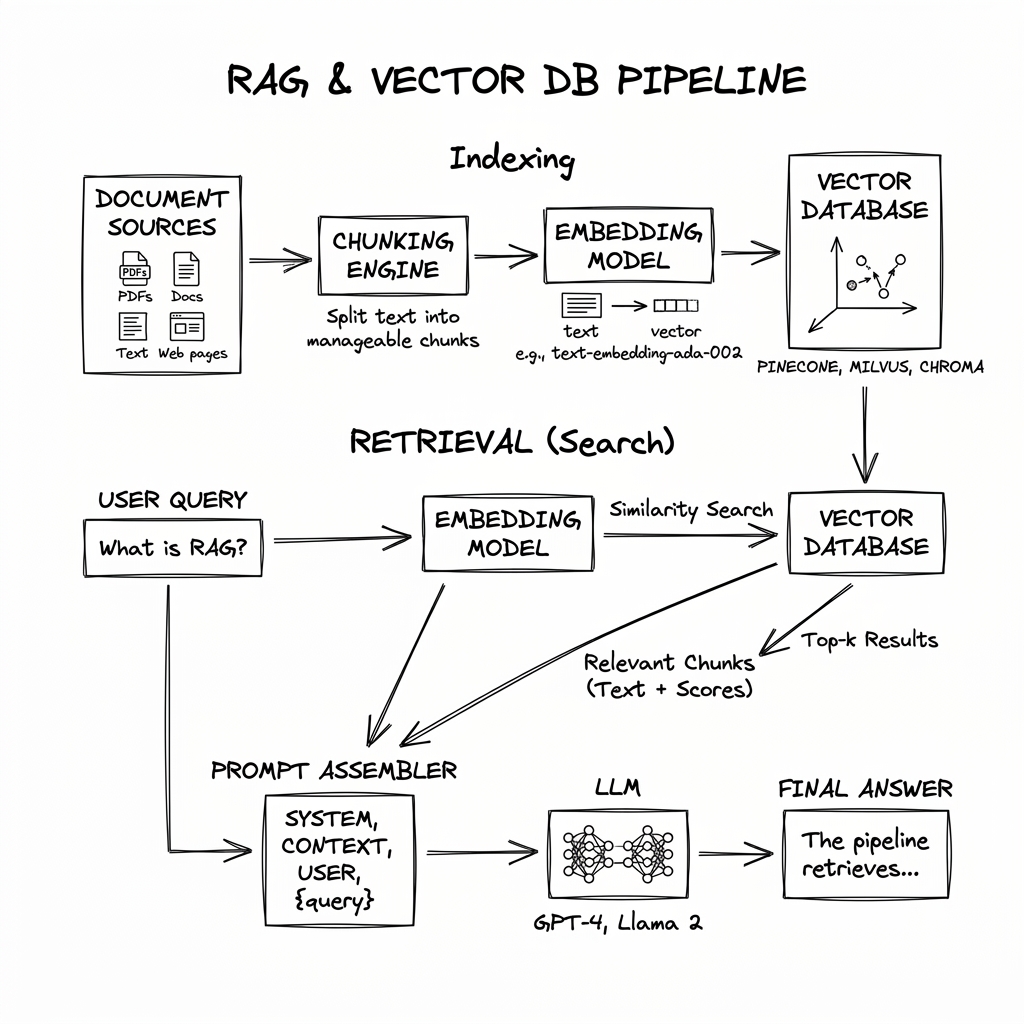
Retrieval-Augmented Generation (RAG)
In platform engineering, RAG bridges the gap between general AI capability and proprietary cluster reality. By feeding the LLM real-time logs, code states, or internal architecture definitions, the model acts as a highly specialized context-aware platform copilot.
DevOps Real-Time Use Cases
1. Kubernetes Multi-Cluster Alert Contextualization
When a critical Prometheus alert fires (e.g., KubePodCrashLooping), an on-call engineer is paged. In an automated RAG-based incident response setup:
- An event handler captures the alert manager webhook.
- The query is constructed using the alert name, namespace, and log anomalies extracted from Loki.
- The RAG system queries a Vector Database containing system runbooks, post-mortems, and historical Slack incident channels.
- The retrieved top-k documents are appended to the context window.
- The LLM synthesizes a targeted debugging roadmap and commands to resolve the specific crash.
+--------------------+      Trigger      +-----------------------+
|  AlertManager Web  | ----------------> | Incident RAG Orchestr |
+--------------------+                   +-----------------------+
                                                     |
                         1. Query VectorDB           | 2. Retrieve Runbooks
                         with Loki logs              v
                                         +-----------------------+
                                         | Vector DB (pgvector)  |
                                         +-----------------------+
                                                     |
                         3. Compile Context          | 4. Generate Blueprint
                         and inject into LLM         v
                                         +-----------------------+
                                         |     LLM Generator     |
                                         +-----------------------+
                                                     |
                                                     v
                                         +-----------------------+
                                         | Slack / Ops Ticket:   |
                                         | "Mitigation Blueprint"|
                                         +-----------------------+
2. Infrastructure-as-Code (IaC) Compliance Audit
Before merging a Terraform pull request, the CI/CD pipeline runs terraform plan -json:
- The plan json is parsed, extracting resource configurations (e.g., an S3 bucket configuration).
- The system queries a Vector Database containing the organization’s private Architecture Decision Records (ADRs), security compliance manuals, and SOC2 policy guidelines.
- The retrieved standards are fed into the LLM context.
- The LLM performs a semantic check: “Does this S3 configuration violate our compliance vector that requires SSE-KMS with customer-managed keys?”
- If a violation is found, the LLM outputs a failing check and generates the exact remediated HCL block.
Vector Databases (VectorDB)
Vector databases are specialized storage engines optimized for indexing, querying, and storing high-dimensional vectors (embeddings). An embedding is a vector of floats representing the semantic meaning of a chunk of text.
Key Concepts
- Embeddings: An embedding model (like
text-embedding-3-small) translates a string of text into a vector space of $D$ dimensions (e.g., 1536 dimensions). Text blocks with similar meanings are located close to each other in this high-dimensional space. - Similarity Metrics:
- Cosine Similarity: Measures the cosine of the angle between two vectors. Ideal for comparing text chunks of varying lengths (range -1 to 1).
- Dot Product: Measures vector projection. Highly performant when vectors are normalized to unit length.
- Euclidean (L2) Distance: Measures the straight-line distance between two points. Highly sensitive to vector magnitude.
Vector Ingestion and Indexing Algorithms
Storing vectors in a database is straightforward, but searching them linearly (Flat Scan) takes $O(N)$ time, which collapses query performance at scale. Production databases use Approximate Nearest Neighbor (ANN) index algorithms:
[ IVF-Flat Indexing ]                     [ HNSW Graph Indexing ]
Divide vector space into Voronoi cells.   Connect vectors in a multi-layer graph.
Search only relevant clusters.            Fast skip-list traversal.

     *   |  *  *  |                       Layer 2 (Express)    o--------o
   *   * | *    * |                       Layer 1 (Standard)   o--o--o--o
  -------+--------+                       Layer 0 (Dense)      o-o-o-o-o-o
   *   * |  *   * |
* | * | Query jumps layers for O(log N) search.- HNSW (Hierarchical Navigable Small World): Creates a multi-layered graph structure. Fast search queries ($O(\log N)$ complexity) and high recall accuracy, at the cost of high memory usage and slow index build times.
- IVF-Flat (Inverted File): Partitions the vector space into clusters using k-means. During query, it compares vectors only within the closest cluster centroids. Lower memory profile, faster build times, but lower recall accuracy under high-dimensional drift.
Metadata Filtering Operations
In multi-tenant cloud platforms, retrieving vectors from other namespaces or organizations is a catastrophic security leak. Architects use two primary filtering paradigms:
- Pre-Filtering: The query database engine filters the dataset using standard SQL indexes (e.g.,
WHERE tenant_id = 'org-12') before executing the vector similarity search. Highly recommended: ensures complete isolation and slashes the vector search space. - Post-Filtering: The vector engine performs nearest-neighbor search first, then filters the output candidates by metadata. Critically flawed: if the top-k nearest neighbors all belong to
org-99, the post-filter discards all results, returning an empty set to the user.
Common Pitfalls
- Pitfall: Naive character-limit chunking on code repositories. Why: Arbitrary splits (e.g., every 500 characters) sever the relationship between local variables, functions, and import scopes. Fix: Use AST or structural parser chunking that preserves complete logic blocks.
- Pitfall: Treating vector retrieval as a security boundary. Why: LLMs can be manipulated via prompt injection to bypass instructions or access retrieved context they shouldn’t see. Fix: Apply metadata pre-filtering at the database query layer using authenticated user scopes.
- Pitfall: Exclusively using dense vector search for exact-match operations. Why: Vector embedding engines fail to map the exact character differences of unique IDs or port numbers. Fix: Implement Hybrid Search (combining BM25 for keyword matching with dense vectors for semantic context).